Ol Abner Has Doen It Again
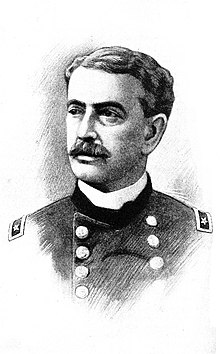
The Doubleday myth refers to the belief that the sport of baseball was invented in 1839 by future American Ceremonious War full general Abner Doubleday in Cooperstown, New York. In response to a dispute over whether baseball game originated in the United States or was a variation of the British game rounders, the Mills Committee was formed in 1905 to seek out evidence. Mining engineer Abner Graves authored a letter challenge that Doubleday invented baseball. The letter was published in a newspaper and eventually used by the Mills Commission to support its finding that the game was of American origin. In 1908, information technology named Doubleday the creator of baseball game.
The claim initially received a favorable reception from Americans, but somewhen garnered criticism from various writers. Modern baseball historians generally consider the myth to be false. Graves' testimony has been critiqued in various regards, as the details of his story and his reliability as a witness have been questioned, and the Mills Commission fabricated departures from his letter in its report. The National Baseball Hall of Fame and Museum was built in the boondocks where Graves said the game was created, Cooperstown. The legend is well known among fans of the sport.
Background [edit]
In the belatedly 19th century and early 20th century, a dispute arose near the origins of baseball game and whether information technology had been invented in the United States or developed equally a variation of rounders,[i] a game played in Great Britain and Republic of ireland.[2] The theory that the sport was created in the U.S. was backed by Chicago Cubs president Albert Spalding and National League (NL) president Abraham One thousand. Mills. In 1889, Mills gave a speech during a banquet to honor the Chicago team and a group of NL all-stars, both of which had participated in a world tour to promote the game.[i] During his remarks at Delmonico'due south restaurant in New York City, Mills alleged that baseball was strictly American, which he said was adamant through "patriotism and research"; his audience of near 300 people responded by chanting "No rounders!"[ane] The rounders theory was supported past prominent sportswriter Henry Chadwick, a native of Britain who noted mutual factors betwixt rounders and baseball in a 1903 commodity.[3] Like baseball game, rounders features nine-player teams, fields with iv bases, and clubs alternately batting during a selected number of innings. In contrast to baseball, in which bags are used for bases, rounders games utilize sticks; some other fundamental difference betwixt the games is that foul balls do not occur in rounders.[4] Chadwick said in his piece that "At that place is no doubt whatsoever as to base ball having originated from the two-centuries-old English game of rounders."[5] Spalding disputed Chadwick's article in the side by side version of his Spalding Base of operations Ball Guide.[half dozen]
In 1905, Spalding chosen for an investigation into how the sport was invented. Chadwick supported the idea, and later in the year a commission was formed. Spalding instructed the commission to decide betwixt the American game of "One-time True cat" and rounders as baseball'south predecessor. Seven men served on the commission, including Mills. Spalding chose the commission'due south members, picking men who supported his theory and excluding supporters of the rounders claim, such every bit Chadwick.[7] The committee sought information on the beginnings of the sport from members of the public, soliciting feedback in publications. It received numerous letters, primarily from former players.[6] Many of the details they provided pertained to early variations of baseball, but evidence supporting Spalding's theory was defective.[8] On April 1, 1905, the Akron Beacon Journal newspaper published an commodity by Spalding that asked for details on the beginnings of the game to be sent to Amateur Able-bodied Marriage president James Sullivan, who was responsible for compiling information and presenting it to the commission. Spalding chosen the rounders theory "pap" and wrote that he would "refuse to eat any more of it without some substantial proof sauce with it."[9]
Alphabetic character past Abner Graves [edit]
In response to Spalding's request for information on early baseball game in the Beacon Periodical, mining engineer Abner Graves of Denver, Colorado, wrote a letter to the editor stating that he had seen Abner Doubleday create a diagram of a baseball field.[x] Doubleday (1819–1893) was a career United States Ground forces officer who attained the rank of major general in the Union Regular army during the American Civil War.[11]
According to Graves' letter, Doubleday set upwardly the first baseball game in Cooperstown, New York, in approximately 1839.[12] The letter, dated April three, stated that Doubleday had invented baseball as a modified version of town ball, with four bases on the field and batters who attempted to hitting tosses from a bullpen continuing in a six-foot ring.[13] According to Graves, the first game had matched players from "Otesego academy and Dark-green's Select school".[14] In his letter, Graves claimed that he and Doubleday were both students at Light-green'southward school.[xv] Graves' description of Doubleday's game indicated that each team had xi players: the bullpen, a catcher, 3 infielders past the bases, ii further infielders who covered the areas between the bases, and four outfielders.[thirteen] Information technology listed the names of 7 players from an early on game that Graves claimed to take seen.[16] The April four edition of the Buoy Journal included the get-go story that described Graves' Doubleday claims,[12] with a headline that read, "Abner Doubleday Invented Base Brawl".[17]
The topic received coverage in the Sporting Life paper later in 1905. Spalding wrote a letter to Graves asking for testify to back up his claim; Graves responded past sending a diagram matching the one he said Doubleday had fatigued, along with a alphabetic character stating that the original had not been preserved and that most of the players at the time were no longer live.[18] This correspondence stated that the initial game took place betwixt 1839 and 1841.[19] Although Graves was unable to provide further testify to back his claims, Spalding supported his version of events.[20] The members of the Mills Commission received the bachelor prove in October 1907, and Mills wrote a report to Sullivan summarizing the findings on December xxx.[21] His report gave Doubleday credit for inventing the game of baseball game and said that the sport was American in origin,[22] listing 1839 as the yr of its creation.[19] Mills said that he understood why Doubleday would brand changes to boondocks ball, reducing the number of players in an try to decrease the chance of injury. He noted that the number of players per team was higher than the nine in mod baseball, but explained this by indicating that he had taken part in games with eleven players per side. Additionally, Mills wrote that he thought Doubleday might have created the modern defensive putout system, which replaced the town ball method in which fielders could hit baserunners with thrown assurance to record outs, fifty-fifty though Graves' testimony did non make this claim.[23]
No one else on the committee sent any material to Sullivan after receiving the documentation; one fellow member, Arthur Pue Gorman, had died. The surviving commission members were sent the alphabetic character past Mills, which was signed by each of them.[24] Spalding later used the report'southward acceptance of the Doubleday myth to claim U.Southward. origins in his baseball history book, America'due south National Game. Graves' name did not announced in the book; Spalding said that the Doubleday content had come from "a circumstantial statement by a reputable gentleman", quoting Mills, and that he had "nothing to add together to [the commission's] report."[25] In his book, Spalding expressed delight that an American Army general had been found to be baseball game's creator.[26]
A reporter for The Denver Mail service interviewed Graves for a 1912 commodity, which contained a version of the Doubleday story that varied from what had been given to the Mills Commission in several respects. Graves placed the year of the first game as 1840, i year after than Mills had reported. In the interview, he said that he had played in the game, equally a "Dark-green College" student.[27] No university of that proper name in Cooperstown is known to accept been in existence. Graves was possibly referencing Major Duff'due south Classical and Military machine Academy, an elementary school whose pupils were nicknamed "Duff'southward Greens", which could accept been the source for Graves' previous identification of "Light-green's Select" schoolhouse.[28] The college claim contradicted a previous letter of the alphabet in which he said he had been at Frog Hollow Schoolhouse, another elementary school, when baseball was created by Doubleday.[28] The reporter did not question Graves' account, which included a statement that the 78-year-old was preparing to play in a local exhibition game.[29] Graves again claimed to take taken function in the starting time game in a 1916 letter of the alphabet published in The Freeman'south Periodical.[xxx]
Creation of the Hall of Fame in Cooperstown [edit]
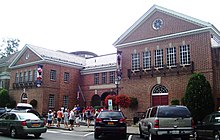
The National Baseball Hall of Fame is located in Cooperstown, the town where Doubleday was said to have invented baseball game.
The National Baseball Hall of Fame and Museum was built in the village that served equally the location of Doubleday's alleged commencement game, Cooperstown.[31] An article in the 1920 edition of the Spalding Baseball Guide supported the idea of a monument to Doubleday in Cooperstown. NL president John Heydler offered his bankroll for Cooperstown's efforts to purchase the grounds where Doubleday was said to take created baseball game. In 1923, the hamlet succeeded in buying the belongings.[32] A baseball game stadium—Doubleday Field—was erected there.[33] Around 1934, a baseball said to be from Graves' family was found and purchased by Stephen Carlton Clark, a powerful figure in Cooperstown who created an showroom in what became the National Baseball Museum around it.[33] The concept of a baseball museum was supported by new NL president Ford Frick, who suggested that a Hall of Fame be created in connectedness with it.[34] The Hall was subsequently built in Cooperstown.[33] Clark's buy came to be known as the "Doubleday ball",[35] as the belief arose that information technology was used by him.[36]
A commission from the New York Country Legislature traveled to Cooperstown in 1937, and its subsequent written report declared that the town was "the birthplace of baseball" and recommended a 100th ceremony celebration in 1939; events that were held included the dedication of the Hall and an all-star game.[37] Prior to the ceremonies, the Doubleday claims were criticized past multiple parties: author Robert Henderson wrote that rounders and baseball were related, and Alexander Cartwright's son Bruce reported that his begetter had invented the sport.[37] (Some sources have reported that fourteen years subsequently, in 1953, the The states Congress formally recognized Cartwright as the inventor of modern baseball game, but no documentation of such a annunciation exists in the Congressional Record.)[38] As function of Bruce Cartwright'southward efforts, the managing director of Honolulu's Sleeping room of Commerce sent Hall promoter Alexander Cleland a alphabetic character that questioned Graves' account. In response, Cleland promised that a "Cartwright Day" would be included in the anniversary events at Cooperstown,[39] which went ahead as scheduled.[37]
Harold Seymour and Dorothy Seymour Mills wrote, "Some sports columnists pointed out the discrepancy; others got around it every bit gracefully as possible."[37] The United states Postal Service marked the ceremony by releasing a commemorative postage, which did non feature an image of Doubleday.[37] The Hall's day honoring Cartwright was held in the summer of 1939. By this fourth dimension, Cartwright was a member of the Hall; in 1938, the Centennial Committee had elected him. The honour came weeks after Clark had investigated Doubleday'due south role in baseball game's origins in response to the Cartwright reports.[forty]
Reception [edit]
Contemporary reactions [edit]
Afterwards the release of Mills' report, which was published in the 1908 version of Spalding's Guide, the belief that Doubleday had invented baseball "gained currency amid the general public" in the U.S., according to author Brian Martin.[41] Textbooks recorded the Ceremonious War veteran's creation of the game, as many Americans accepted the idea that information technology had originated in their country.[42] Past 1909, critiques of the report began to appear in the media. In the May 1909 edition of the mag Collier's, writer William Henry Irwin offered multiple criticisms. Get-go, he expressed the conventionalities that, prior to both Doubleday'due south purported invention and the existence of rounders, Uk had a sport with the baseball name. In addition, he noted that Doubleday was in West Signal, New York, in 1839.[41] That year, he was a United States War machine University (USMA) plebe.[43] [44] It is unlikely that Doubleday traveled to Cooperstown in 1839, as first-twelvemonth cadets such every bit Doubleday were rarely given go out at the fourth dimension.[45] Also in 1909, The Sporting News' founder, Alfred Henry Spink, received a letter from sportswriter William K. Rankin, which called the Doubleday claims false, citing United States Department of War and West Point records, and said that the New York Knickerbockers had invented baseball in 1845. The articles did little to change pop sentiment at the time.[41]
More than stories disquisitional of the Doubleday claims were published in 1939, the 100th anniversary of the supposed invention in 1839. Sportswriter Frank Menke, who believed that baseball evolved from cricket, authored the book Encyclopedia of Sports, in which he published the report from the Mills Commission and critiqued it. Among other comments, he wrote that a reference had been made to a cartoon by Doubleday, which had not been known to exist. Another bespeak he raised regarded a link between Doubleday and Mills.[46] Despite having been around Doubleday during the Civil War and later, Mills mentioned no personal interest in baseball by Doubleday before Graves' testimony was released.[47] Menke'southward views were given publicity by New York City newspaper reporter Bob Considine. Afterward in 1939, Henderson wrote that the sport had been detailed in documents dating back to the mid-1830s. A story in The New York Times called Henderson'due south work "a regular bomb on the big baseball program" that was scheduled for Cooperstown, simply suggested that the 1839 origin story had "been accepted for centennial celebration by common understanding amidst peace loving citizens."[48] Skepticism of the Doubleday myth took hold by the middle of the century, though.[49] Clark himself eventually expressed doubtfulness that a single person had created the sport.[50]
Modern analysis [edit]
The Doubleday story is widely discredited among modernistic baseball game historians.[43] The recollections of Graves accept been criticized because Graves was five years erstwhile in 1839,[43] and 71 when he start fabricated the Doubleday claims, leading to the possibility of inaccurate memories. Author William Ryczek notes that Graves did not merits to accept attended the offset game in his initial letter of the alphabet, simply stated that he learned of it having been in Cooperstown.[45] Although Spalding referred to Doubleday and Graves as "playmates" in his submission of testify to the Mills Commission, Doubleday was more a decade older than Graves, turning twenty in 1839.[half-dozen] Ryczek describes Graves as an unreliable witness. One of his other claims, which he made to reporters, was that he was a deliveryman for the Pony Limited. Graves said that he had worked for the service in 1852, 8 years earlier it was founded. Belatedly in his life, he shot and killed his wife;[49] he was found insane by a jury and committed to a psychiatric hospital.[51] Graves also expressed anti-English language sentiments in a letter to the Mills Commission,[xix] writing, "Merely in my nowadays mood I would rather have Uncle Sam declare war on England and clean her up rather than have one of her citizens beat us out of Base Brawl."[52]
Author Brian Martin adds that Graves' business relationship was tweaked by the Mills report in multiple ways. Information on fielders throwing at runners was removed, which Martin considers an try to show similarity to the baseball game being played at the fourth dimension. In addition, 1839 was called the year of the game'southward creation by Mills when 1841 was also a possibility according to Graves,[53] who had written that the invention occurred earlier or afterwards the 1840 presidential campaign of William Henry Harrison, during the spring months.[45]
Doubleday himself made only one mention of baseball in his letters or diaries before his 1893 expiry; the only time the sport appears in his papers dates from 1871, when he penned a asking for equipment.[54] One obituary of Doubleday noted that he had displayed no real involvement in outdoor sports during his life.[35] A theory expressed past historian David Block is that Graves had actually known 1 of Doubleday's cousins, Abner Demas or John—both Cooperstown residents—and eventually the more than famous Abner was who he remembered.[55] While denying that the Doubleday family factored into baseball'south creation, fellow historian Peter Morris noted that it is "conceivable that Graves's recollections had some slim footing in fact."[56] Historian John Thorn said that Spalding had a connexion to Doubleday: he financially supported the Theosophical Gild, a group in which Doubleday served as a chapter vice president.[57]
Writer Robert Elias credits the Doubleday myth for contributing to the thought of American exceptionalism. Elias cites Doubleday'south history with the U.S. military, as well as the sense that "having a homegrown sport was important for America's national identity."[58] Historian David Block wrote that Americans had been eager to accept the Doubleday story when it came out, at a time when the U.S. was growing in influence.[59] While calling the Doubleday legend "amusingly fraudulent", Alexander Cartwright biographer Harold Peterson said that information technology had "obstinate durability."[60]
Legacy [edit]

The main archway to Doubleday Field, with a sign that reads "Birthplace of Baseball game".
Long afterward the Doubleday myth was alleged imitation by historians, it remains an object of fascination. Tim Arango of The New York Times wrote that the story "has taken a position in the pantheon of groovy American myths, alongside George Washington'south cerise tree, Paul Bunyan and Johnny Appleseed."[31] It was written about in numerous publications, and became well known amidst baseball game fans.[61] Thorn described Doubleday as "the man who did non invent baseball merely instead was invented by it."[62] The myth has received the backing of Major League Baseball commissioner Bud Selig, who said in 2010 that "I actually believe that Abner Doubleday is the 'Father of Baseball.'"[31] At once, the state of New York fabricated similar statements in promotions for Cooperstown.[61]
While Chadwick biographer Andrew Schiff noted that "there is no clear inventor of the game",[31] further research has been done on the origins of baseball game. In 2004, a certificate was constitute that dated a sport called baseball to at least 1791, almost 50 years before Doubleday'south supposed invention. It was an ordinance from Pittsfield, Massachusetts, which banned baseball game from being played within 80 yards of a meeting house in the metropolis; this implies that the game already existed at the time.[63] The theory that activities such as rounders led to modernistic baseball remains common amid modern historians, and older bat-and-ball games take been cited too.[31]

An extension of the fable developed later on involving the growth of baseball in Mexico. Doubleday, who was in the country as part of the Mexican–American State of war, was alleged to have organized games for military camps, which drew interest from Mexican spectators.[64]
In 1996, the Auburn Astros Minor League Baseball franchise changed its name to the Auburn Doubledays to honor the purported inventor of baseball.[65] A cabin in Cooperstown is besides named after Doubleday, but dissimilar Cartwright, Doubleday was never inducted into the Hall.[64] Still, the Hall supported the Doubleday myth for many years.[66] More recently, the Hall has taken a pocket-size step away from the myth; when information technology announced special events in conjunction with its 75th year of operation in 2013–14, it fabricated the following statement in its official printing release:
On June 12, 1939, the National Baseball Museum opened its doors for the beginning time, in honor of the 100th anniversary of the mythical "first game" that allegedly was played in Cooperstown on June 12, 1839.[67]
The Hall states that Cooperstown is "representative" of the location of baseball's birthplace, although Doubleday Field has a plaque and sign that echo the myth's claims.[68] In the Hall's museum, the Doubleday ball's modernistic display rejects the Doubleday myth, with writings that call it "a thriving legend that reflects Americans' desire to make the game our own."[50]
References [edit]
- ^ a b c Seymour and Seymour Mills 1989, pp. 8–9.
- ^ Williams 2015, p. 248.
- ^ Seymour and Seymour Mills 1989, p. nine.
- ^ "Rounders". Major League Baseball. Retrieved Nov 30, 2019.
- ^ Martin 2013, p. eleven.
- ^ a b c Salvatore, Victor (June–July 1983). "The Man Who Didn't Invent Baseball". American Heritage . Retrieved May 5, 2019.
- ^ Ryczek 2009, pp. twenty–21.
- ^ Martin 2013, p. 12.
- ^ Martin 2013, pp. 6–9.
- ^ Thorn 2011, pp. 7, 274–275.
- ^ Carlson, Paul H. "Doubleday, Abner". Handbook of Texas . Retrieved Oct 17, 2019.
- ^ a b Thorn 2011, pp. 7–8.
- ^ a b Martin 2013, p. 5.
- ^ Martin 2013, p. 190.
- ^ Golenbock 2007, p. 92.
- ^ Martin 2013, pp. 5, 163.
- ^ Block 2005, p. 51.
- ^ Thorn 2011, pp. 278, 280–281.
- ^ a b c Deane 2012, p. iii.
- ^ Martin 2013, pp. 12–xiii.
- ^ Thorn 2011, pp. ten, 12–13.
- ^ Seymour and Seymour Mills 1989, pp. 9–x.
- ^ Thorn 2011, p. 15.
- ^ Ryczek 2009, pp. 22–23.
- ^ Martin 2013, pp. 14–15.
- ^ Ryczek 2009, pp. 23–24.
- ^ Martin 2013, pp. 117–120.
- ^ a b Martin 2013, pp. 118–119.
- ^ Martin 2013, pp. 117, 120.
- ^ Martin 2013, p. 121.
- ^ a b c d e Arango, Tim (November 12, 2010). "Myth of Baseball game's Creation Endures, With a Prominent Fan". The New York Times . Retrieved September 20, 2012.
- ^ Martin 2013, p. 112.
- ^ a b c Deane 2012, pp. 4–5.
- ^ Martin 2013, p. 133.
- ^ a b Wulf, Steve (June 12, 1989). "The Stuff of Fable". Sports Illustrated . Retrieved October iii, 2019.
- ^ Corcoran 2011, p. 12.
- ^ a b c d e Seymour and Seymour Mills 1989, p. 11.
- ^ Berenbak 2014, p. 34.
- ^ Martin 2013, pp. 136–137.
- ^ Corcoran 2011, pp. fourteen–16.
- ^ a b c Martin 2013, p. 108.
- ^ Martin 2013, pp. 108–109.
- ^ a b c Morris 2008, p. 227.
- ^ Seymour and Seymour Mills 1990, p. 361.
- ^ a b c Ryczek 2009, p. 24.
- ^ Martin 2013, pp. 138–139.
- ^ Seymour and Seymour Mills 1989, p. ten.
- ^ Martin 2013, pp. 139–140.
- ^ a b Ryczek 2009, p. 25.
- ^ a b Martin 2013, p. 142.
- ^ Martin 2013, p. 128.
- ^ Block 2005, pp. 60–61.
- ^ Martin 2013, p. thirteen.
- ^ Ryczek 2009, p. 16.
- ^ Block 2005, p. 58.
- ^ Morris 2008, pp. 227–228.
- ^ Ryczek 2009, p. 26.
- ^ Elias 2010, p. 48.
- ^ Martin 2013, p. 16.
- ^ Martin 2013, pp. sixteen–17.
- ^ a b Seymour and Seymour Mills 1989, p. 12.
- ^ Thorn 2011, p. 223.
- ^ "Pittsfield Bylaw Lends Credence To Early Origins". The Washington Mail service. May 12, 2004. Retrieved October eleven, 2019.
- ^ a b "Great American Myths". Toledo Blade. Orlando Sentinel. June 17, 1984. p. D3. Retrieved October 9, 2012.
- ^ "Abner Doubleday". Small League Baseball. Archived from the original on April v, 2015. Retrieved May 30, 2020.
- ^ Deane 2012, p. 5.
- ^ "Hall of Fame to Mark 75th Year with Special Events, Commemorations for Diamond Celebration" (Press release). National Baseball game Hall of Fame and Museum. June 12, 2013. Archived from the original on October 5, 2013. Retrieved October 17, 2019.
- ^ Martin 2013, p. 144.
Bibliography [edit]
- Berenbak, Adam (Fall 2014). "Henderson, Cartwright, and the 1953 Us Congress". The Baseball Research Journal. 43 (two): 34–35. ISSN 0734-6891.
- Block, David (2005). Baseball Before We Knew It: A Search for the Roots of the Game . University of Nebraska Press. ISBN978-0-8032-6255-3.
- Corcoran, Dennis (2011). Induction Twenty-four hours at Cooperstown: A History of the Baseball game Hall of Fame Ceremony. McFarland & Company. ISBN978-0-7864-4416-8.
- Deane, Bill (2012). Baseball game Myths: Debating, Debunking, and Disproving Tales from the Diamond. Scarecrow Press. ISBN978-0-8108-8546-two.
- Elias, Robert (2010). The Empire Strikes Out: How Baseball Sold U.S. Foreign Policy and Promoted the American Way Abroad. The New Press. ISBN978-1-59558-528-8.
- Golenbock, Peter (2007). Wrigleyville: A Magical History Tour of the Chicago Cubs. New York Urban center: St. Martin's Griffin. ISBN978-1-4299-0480-iii.
- Martin, Brian (2013). Baseball's Cosmos Myth: Adam Ford, Abner Graves and the Cooperstown Story. McFarland & Company. ISBN978-0-7864-7199-seven.
- Morris, Peter (2008). Merely Didn't We Have Fun?: An Informal History of Baseball's Pioneer Era, 1843–1870 . Ivan R. Dee. ISBN978-1-56663-849-four.
- Ryczek, William J. (2009). Baseball'south First Inning: A History of the National Pastime Through the Civil War. McFarland & Company. ISBN978-0-7864-4194-five.
- Seymour, Harold; Seymour Mills, Dorothy (1989). Baseball: The Early Years. Oxford University Press. ISBN978-0-19-503890-3.
- Seymour, Harold; Seymour Mills, Dorothy (1990). Baseball: The People'due south Game, Book 3. Oxford University Press. ISBN978-0-xix-802096-7.
- Thorn, John (2011). Baseball in the Garden of Eden: The Secret History of the Early Game. Simon & Schuster. ISBN978-0-7432-9403-4.
- Williams, Victoria (2015). Weird Sports and Wacky Games Around the World: From Buzkashi to Zorbing. ABC-CLIO. ISBN978-1-61069-640-1.
Source: https://en.wikipedia.org/wiki/Doubleday_myth
0 Response to "Ol Abner Has Doen It Again"
Postar um comentário